Yutong ZK6120 & ZK6118 Common Faults: A Parts Checklist for Fleet Buyers
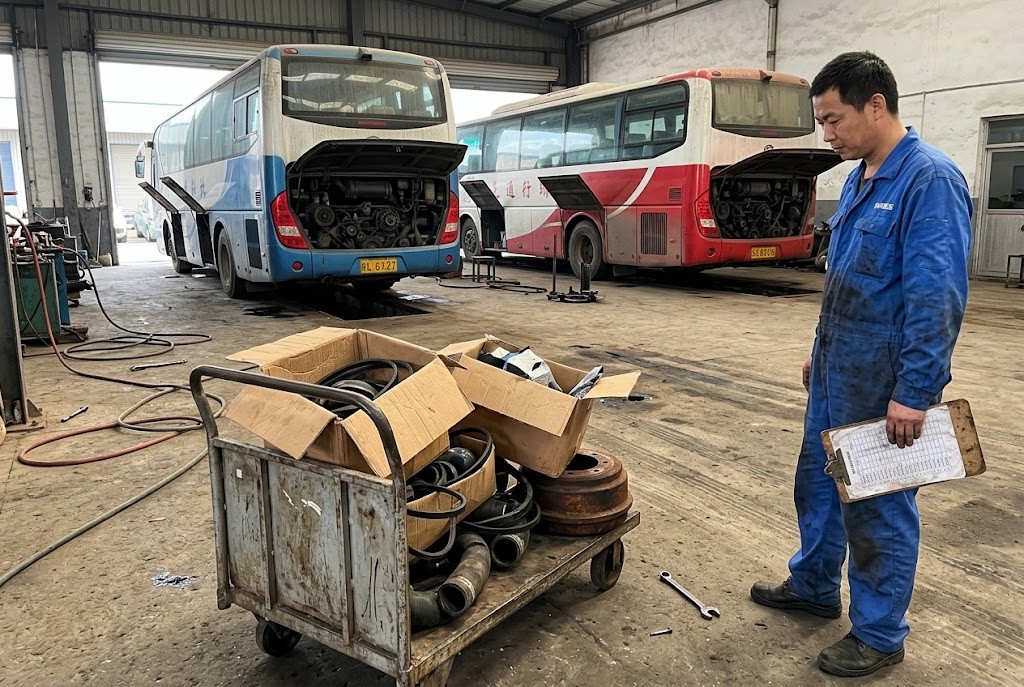
Running a fleet of Yutong ZK6120 or ZK6118 buses1 without a pre-built parts inventory is one of the most predictable ways to suffer preventable downtime. Fleet managers know these buses wear hard, and when a brake system or cooling circuit fails on the road, the question is never "why did it fail?" — it's "why didn't we have the part on the shelf?"
The ZK6120 and ZK6118 share a platform, but several key systems use non-interchangeable parts — particularly in brakes, cooling, HVAC, and suspension. Fleet buyers who order by model name alone, without specifying engine supplier or production year, regularly receive the wrong part. The solution is a fault-driven preventive checklist built around the four systems that generate the most repeat orders and breakdown calls.
Understanding which parts to pre-stock — and why the ZK6120 and ZK6118 are not always interchangeable — is what separates a well-run fleet from one that is perpetually waiting on shipments. The following checklist breaks down the four highest-reorder systems we see at CAANASS, with specific parts named for each.
Are ZK6120 and ZK6118 Parts Interchangeable?
This is the first question we hear from new customers, and the honest answer is: partially. Treating these two models as fully parts-compatible is a procurement mistake that we see regularly, and it leads to returns, delays, and frustrated maintenance crews.
Many structural and body parts overlap between the ZK6120 and ZK6118. However, brake components, cooling system parts, and HVAC assemblies have confirmed non-interchangeable variants between the two models. Engine supplier — YUCHAI or WEICHAI — creates further divergence in cooling and accessory parts. Always confirm model, engine supplier, and production year before ordering.
The compatibility question matters more than most buyers realize at the ordering stage. Here is where we see it go wrong most often.
Where Cross-Ordering Fails Most Often
The three systems where model-to-model substitution fails with the highest frequency in our order history are:
1. Brake System Brake chambers and wheel speed sensors are not universal across ZK6120 and ZK6118 configurations. A ZK6120 with a rear air brake configuration may use a different chamber size and mounting bracket than the ZK6118. Ordering a brake chamber by model name alone — without specifying axle position and brake type — is one of the most common procurement errors we process.
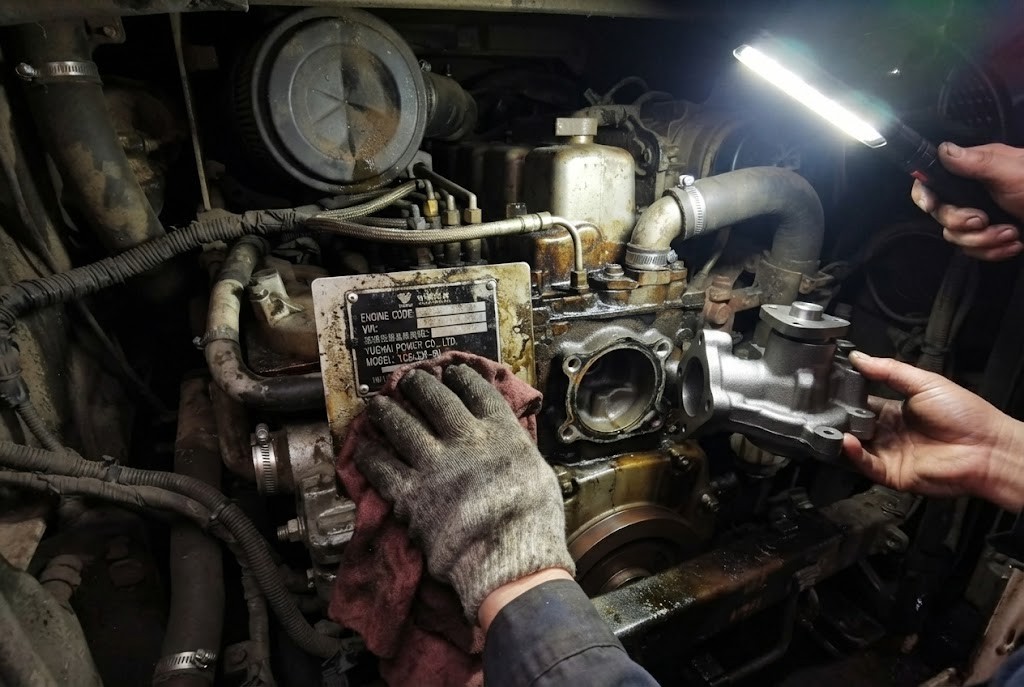
2. Engine Cooling This is where engine supplier divergence hits hardest. A ZK6120 fitted with a YUCHAI engine uses a different water pump, thermostat housing, and coolant hose routing than the same-year ZK6120 fitted with a WEICHAI unit2. We commonly receive inquiries that specify "ZK6120 water pump" with no engine code. Without that code, we cannot confirm the correct part.
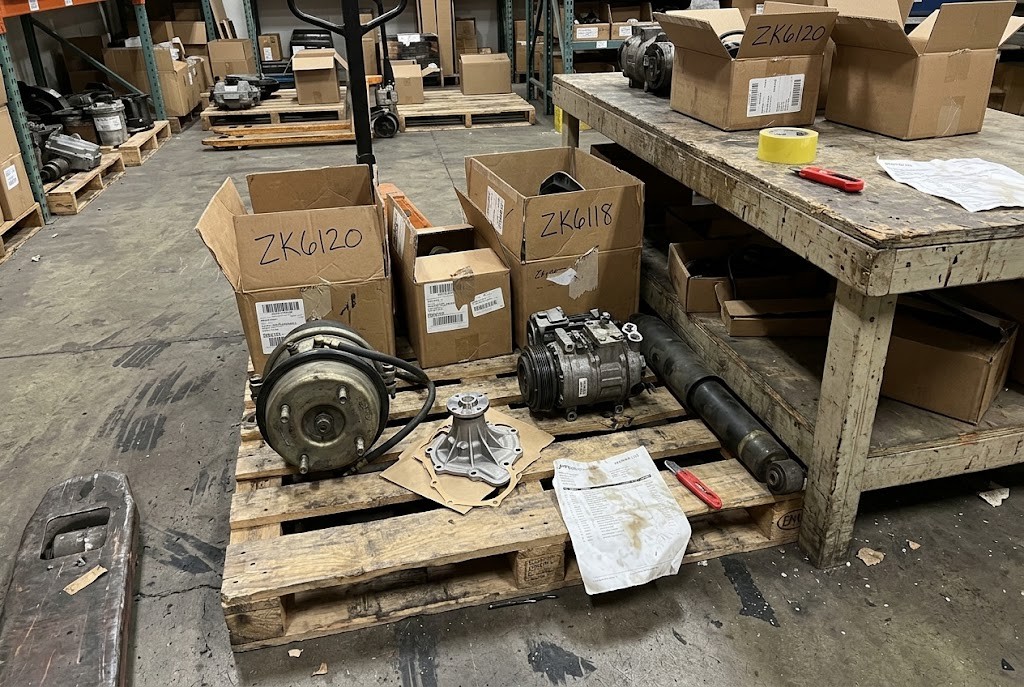
3. HVAC / Air Conditioning AC compressor fitment varies by both model year and roof-mounted versus front-mounted configurations. Customers often describe this fault as "AC compressor not engaging" or "compressor seized," but the replacement unit they need depends entirely on which HVAC system their specific bus was built with. Specifying the compressor brand stamped on the original unit (Sanden, Highly, Bitzer variants appear across these models) significantly speeds up correct identification.
The OEM Number Problem
There is a less obvious compatibility risk that catches experienced buyers off guard: OEM number updates across production years. Yutong revises part numbers as components are superseded3. A buyer ordering a wheel speed sensor using a part number from a 2015 bus may find that number is no longer current for a 2019 build of the same model. The part may look similar but carry different connector pinouts or signal output.
Our advice: Always provide the chassis number (VIN) and engine code when placing an order. At CAANASS, we verify parts against VIN through our professional identification system. This is not a formality — it is the most reliable way to confirm you receive the right part on the first shipment.
What Are the Most Common Fault Systems on ZK6120 and ZK6118 Buses?
Fleet operators across Africa, the Middle East, and Southeast Asia consistently report the same four systems as their most frequent failure and reorder categories4. This is not an engineering analysis — it is an observed pattern from years of customer inquiries and repeat orders at CAANASS.
The four highest-reorder systems for ZK6120 and ZK6118 buses are: brakes, engine cooling, HVAC, and suspension/steering. These systems generate the majority of fault-symptom inquiries we receive and represent the parts most likely to cause fleet immobilization if not held in preventive stock.
Each system below includes the specific parts we most commonly supply, framed as a checklist for procurement managers.
Brake System Parts: What Should Be on Your Shelf?
Brake failures on long-distance bus routes are not gradual — they tend to surface as urgent breakdowns5. Customers often describe the fault as "brake pedal spongy," "air leak from the rear axle area," or "ABS warning light on dashboard." By the time the bus is off the road, the procurement manager is already behind.
The brake components with the highest reorder frequency on ZK6120 and ZK6118 buses are: brake chambers (front and rear, specifying spring brake or service brake type), wheel speed sensors (ABS), brake pads (front disc), slack adjusters, and brake valve assemblies. Specify axle configuration and brake type when ordering.
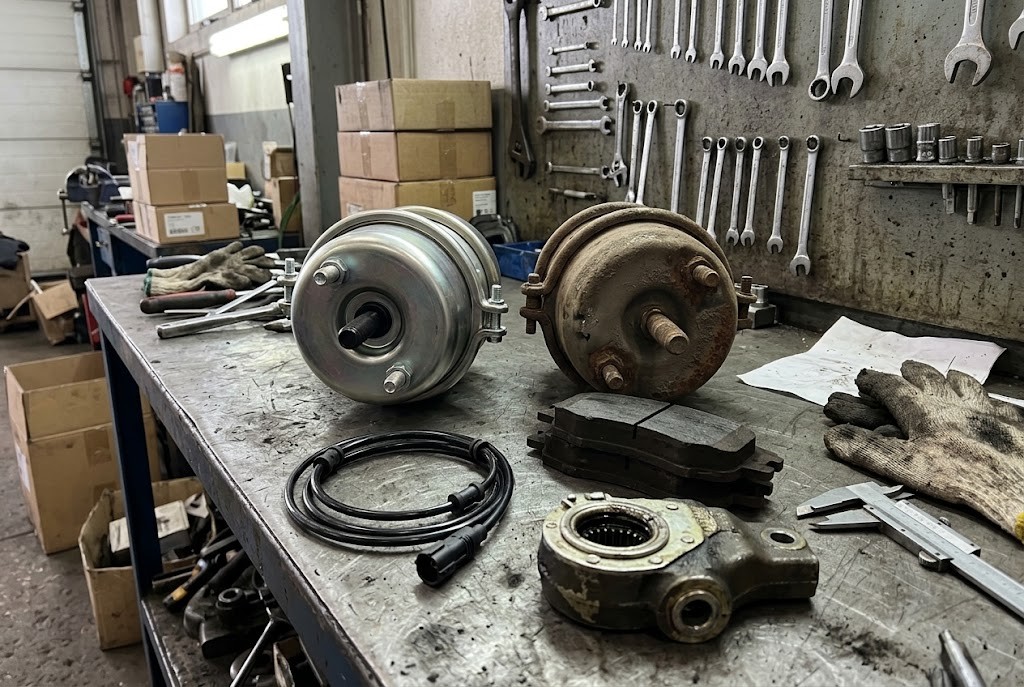
Brake System Checklist — Specific Parts
| Part | Common Fault Description | Key Ordering Detail |
|---|---|---|
| Brake chamber (rear spring brake) | Air leak, brake drag, slow release | Specify spring brake vs. service brake; confirm clamp size |
| Brake chamber (front service) | Soft pedal, delayed response | Confirm bore diameter; front axle spec |
| Wheel speed sensor (ABS) | ABS warning light, instability | Confirm connector type; ZK6120 and ZK6118 variants differ |
| Brake pads (front disc) | Noise, vibration, extended stopping distance | Confirm disc diameter; pad thickness spec |
| Slack adjuster | Uneven brake wear, pulling to one side | Specify manual vs. automatic; confirm arm length |
| Brake valve (foot valve) | Erratic air pressure, pedal feedback issues | Match to brake circuit configuration |
Recommended preventive stock: For a fleet of 10 buses operating on long routes, holding at least two sets of rear brake chambers and four wheel speed sensors is a reasonable starting position. We see fleets in high-dust environments (parts of Sub-Saharan Africa and the Middle East) reorder wheel speed sensors and slack adjusters at notably higher frequency than temperate-climate fleets6.
Engine Cooling System Parts: Why Engine Supplier Matters
Overheating is the fault description we receive most often from customers in hot-climate markets. Customers describe symptoms as "temperature gauge rising," "coolant loss without visible leak," or "heater core not working." Cooling system failures affect both engine reliability and cabin comfort — which matters on passenger buses.
The engine cooling parts with the highest reorder frequency on ZK6120 and ZK6118 buses are: water pumps, thermostats, radiator hoses (upper and lower), coolant expansion tanks, and fan clutches. Engine supplier (YUCHAI or WEICHAI) is mandatory ordering information for water pumps and thermostats — these are not interchangeable between engine brands.
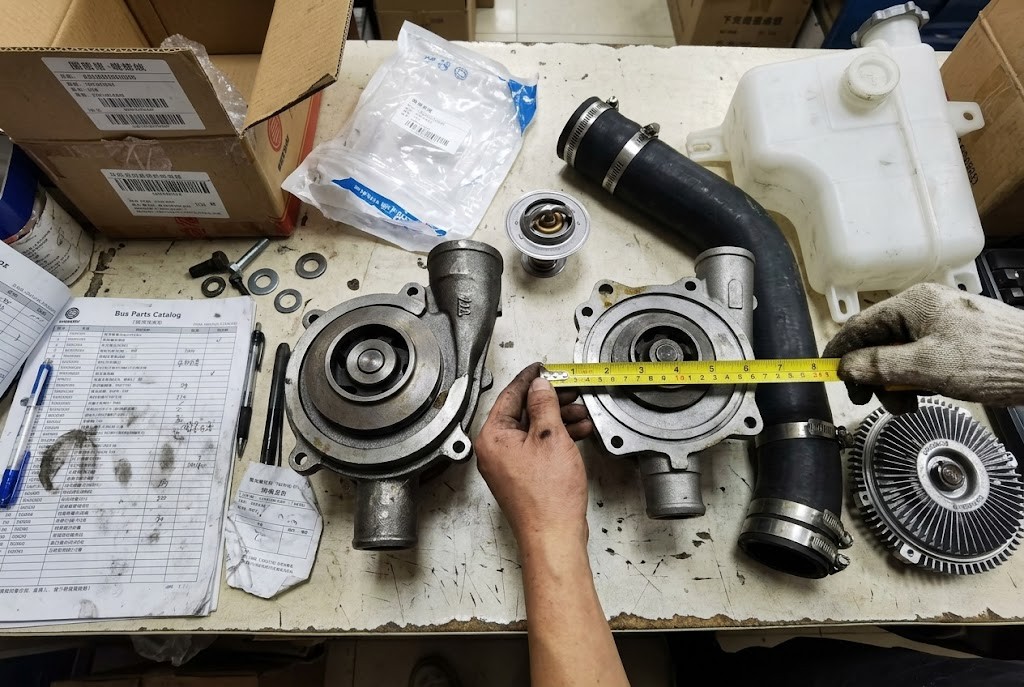
Cooling System Checklist — Specific Parts
| Part | Common Fault Description | Key Ordering Detail |
|---|---|---|
| Water pump | Overheating, coolant leak from front of engine | Must specify YUCHAI or WEICHAI |
| Thermostat | Slow warm-up or chronic overheating | Engine supplier and valve opening temperature |
| Upper radiator hose | Coolant loss, visible cracking or bulging | Confirm hose diameter and length; model year matters |
| Lower radiator hose | Similar to above | As above |
| Coolant expansion tank | Coolant smell in cabin, level dropping | Confirm fitting and cap type |
| Fan clutch | Overheating at idle, excessive fan noise | Engine and fan drive configuration required |
The YUCHAI vs. WEICHAI Divergence in Practice
We regularly receive orders where a customer sends a photo of their water pump and asks for a match. This is the most reliable approach for cooling parts, and we encourage it. When that is not possible, the engine code stamped on the block — or the engine model from the vehicle's documentation — is the next best reference. Ordering "ZK6120 water pump" without this information creates a confirmation step that delays fulfillment and increases the chance of a return shipment.
HVAC and Air Conditioning Parts: Keeping Passengers Comfortable (and the Bus Running)
HVAC failures are a direct passenger service issue. For buses operating in the Middle East, Southeast Asia, or sub-Saharan Africa, a seized AC compressor or failed blower motor can ground a vehicle faster than a mechanical fault — passengers will not board a hot bus in 40°C heat.
The HVAC and air conditioning parts with the highest reorder frequency on ZK6120 and ZK6118 buses are: AC compressors, condenser fans, blower motors (evaporator unit), expansion valves, and AC pressure sensors. Compressor brand and displacement must be specified — multiple compressor variants are fitted across these models.
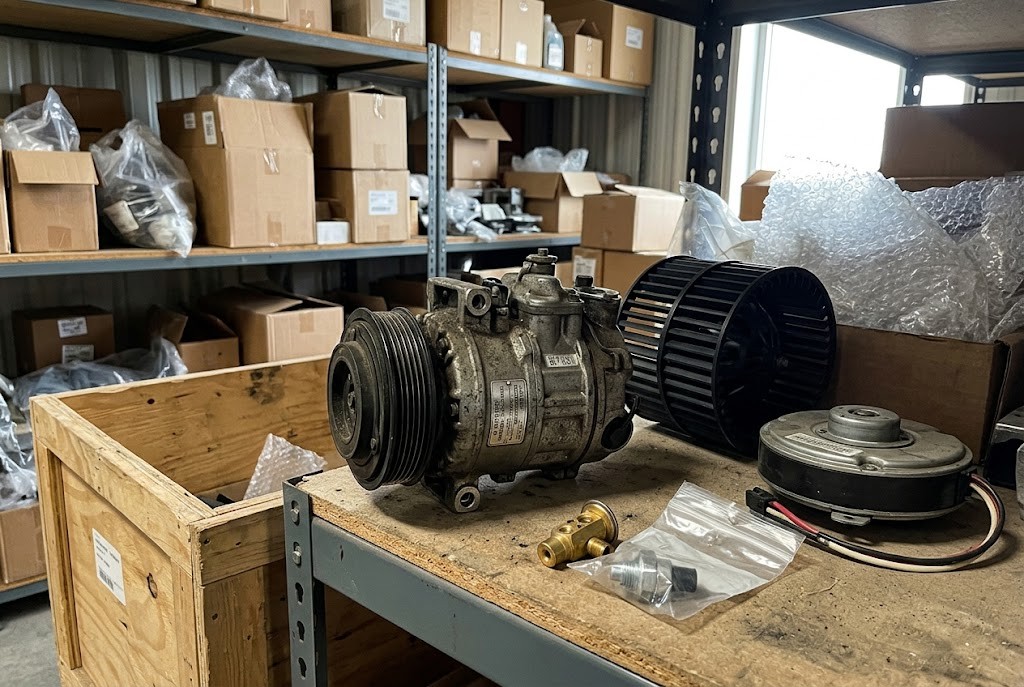
HVAC Checklist — Specific Parts
| Part | Common Fault Description | Key Ordering Detail |
|---|---|---|
| AC compressor | No cooling, compressor clutch not engaging, seized | Specify compressor brand stamped on original unit; displacement |
| Condenser fan motor | Insufficient cooling, condenser overheating | Confirm voltage (12V/24V) and rotation direction |
| Evaporator blower motor | Weak airflow, no airflow, noise | Confirm mounting configuration; roof vs. front unit |
| Expansion valve | Poor cooling performance, icing | Confirm refrigerant type (R134a standard on most7) |
| AC pressure sensor (high/low) | AC system not engaging, fault code | Connector type and thread spec required |
| Compressor clutch/pulley assembly | Clutch slip, noise, failure to engage | Often replaced as assembly; confirm compressor model |
Roof-Mount vs. Front-Mount: A Fitment Detail That Matters
ZK6120 and ZK6118 buses are configured with different HVAC unit placements depending on market specification and year of manufacture. A compressor or blower assembly from a roof-mounted system is not compatible with a front-mounted installation. When customers do not specify this, we ask — because the physical dimensions and hose routing are different. This is a detail that many parts suppliers skip, and it results in returned shipments.
Suspension and Steering Parts: High-Wear, High-Consequence
Suspension and steering wear is gradual — which is exactly why fleets underestimate it until a tie rod end fails at highway speed or a shock absorber bottoms out on a rough road. Customers describe these faults as "pulling to one side," "loose steering," "vibration at speed," or "clunking from the front axle."
The suspension and steering parts with the highest reorder frequency on ZK6120 and ZK6118 buses are: shock absorbers (front and rear), tie rod ends, ball joints, stabilizer bar links, and steering drag links. These are high-wear items in any operating environment and wear faster on unpaved or poorly maintained roads.
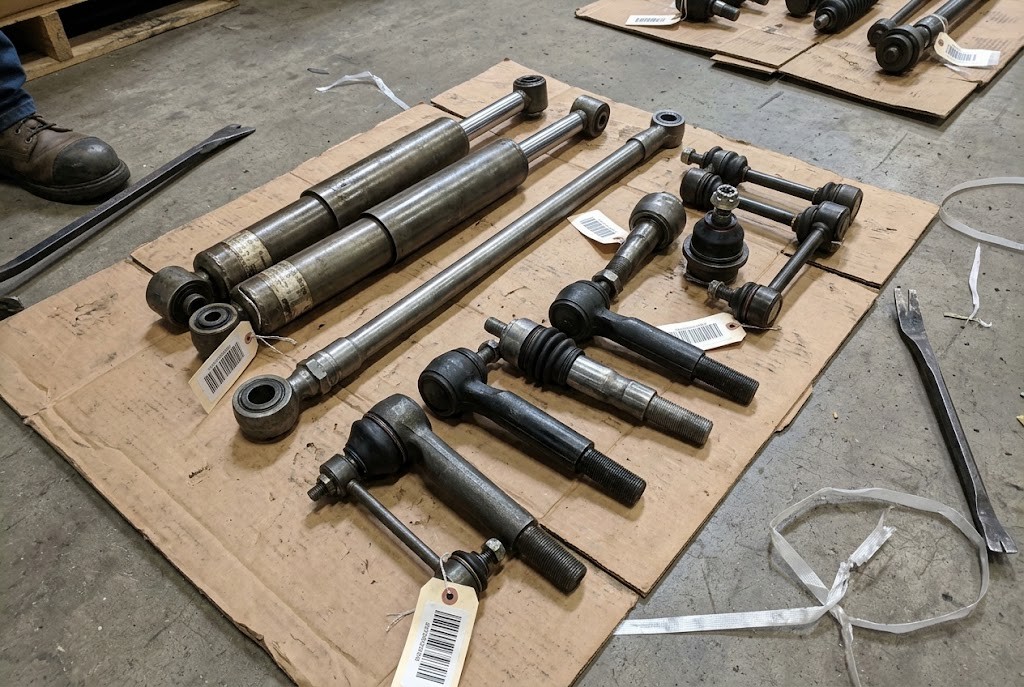
Suspension and Steering Checklist — Specific Parts
| Part | Common Fault Description | Key Ordering Detail |
|---|---|---|
| Front shock absorber | Vibration, bounce, poor ride control | Confirm extended/compressed length; mount type |
| Rear shock absorber | As above, rear axle area | Air spring vs. conventional spring configuration |
| Tie rod end (inner and outer) | Pulling, uneven tyre wear, loose steering | Specify left/right; inner vs. outer; thread direction |
| Ball joint (upper/lower) | Clunking, steering wander | Confirm upper or lower; taper dimension |
| Stabilizer bar link | Knocking over bumps | Confirm link length and end fitting type |
| Steering drag link | Loose or heavy steering | Full assembly vs. end kit; confirm length |
| Power steering pump | Heavy steering, whining noise, fluid leak | Engine supplier may affect mounting configuration |
Why Road Conditions Drive Parts Frequency
Fleets operating on unpaved roads — common in parts of Africa and Central Asia — report suspension wear intervals far shorter than manufacturer service schedules suggest8. We do not publish specific mileage intervals because operating conditions vary too widely for any single figure to be meaningful. What we do observe is that fleets in these markets reorder shock absorbers, tie rod ends, and ball joints more frequently than fleets operating on paved highways. If your routes include significant unpaved mileage, suspension parts belong at the top of your preventive stock list.
Why Reactive Purchasing Is Your Biggest Fleet Risk
Parts price is the metric most procurement managers focus on. Downtime cost is the metric most procurement managers underestimate — until a bus sits idle for two weeks waiting for a brake chamber that was not in stock.
The real fleet risk is not overpaying for a part. It is being unprepared for a fault that was entirely predictable. Brake systems, cooling circuits, HVAC, and suspension components on ZK6120 and ZK6118 buses fail in patterns — the same parts, the same systems, repeatedly. Holding preventive stock of high-wear items from these four systems is the most direct way to reduce fleet downtime exposure.
Consider the logic plainly:
- A brake chamber costs a fraction of a day's lost revenue from an immobilized bus on a commercial route.
- A water pump can be shipped in days if it is in stock at your supplier — or take weeks if it needs to be sourced and cleared.
- An AC compressor failure in summer, in a hot-climate market, is not a "schedule it for next week" repair — passengers will not board, and the bus earns nothing while it waits.
The procurement decision is not whether to buy preventive stock. It is whether to buy it on your schedule, at a planned price, in bulk — or to buy it urgently, at expedited cost, after a breakdown.
We work with fleet operators who send us their bus inventory list and let us build a recommended parts holding against the four systems above. This is not upselling — it is the most practical form of fleet protection we can offer.
Frequently Asked Questions
Can I order ZK6120 parts and fit them to a ZK6118?
In some cases, yes — but not reliably across all systems. Brake chambers, HVAC components, and cooling parts have confirmed non-interchangeable variants between the two models. Always confirm by chassis number (VIN) rather than assuming model-to-model compatibility. When in doubt, contact your supplier with the VIN before ordering.
How do I know whether my ZK6120 has a YUCHAI or WEICHAI engine?
The engine model is stamped on the engine block and should appear in the vehicle's documentation or service records. The engine code is also typically listed on the VIN plate or chassis documentation. For cooling and accessory parts, this is mandatory ordering information — do not skip it.
My OEM part number is not matching anything in your system. Why?
Yutong updates OEM numbers when components are superseded. A part number valid for a 2015 build may not match the current number for the same part on a 2019 build. Provide your chassis number (VIN) and the original part number together — CAANASS can cross-reference against updated numbers and confirm the correct current equivalent.
What is the minimum order for preventive stock on these models?
We work with fleet operators at various order scales. For preventive stock, we typically recommend building a parts holding around the four high-reorder systems, prioritizing brake chambers, wheel speed sensors, water pumps, and AC compressors as the most time-critical parts. Contact us with your fleet size and we will advise on a practical holding quantity.
How quickly can CAANASS ship ZK6120 or ZK6118 parts?
We stock over 40,000 kinds of parts across more than 2,000 square metres of warehouse. For the high-reorder parts listed in this article, stock availability is generally confirmed at the time of inquiry. Lead time depends on destination and shipping method. We recommend confirming stock before finalizing your procurement schedule.
Conclusion
The ZK6120 and ZK6118 are proven platforms, but they are not maintenance-free — and they are not fully parts-interchangeable. The four systems that generate the most fault calls and repeat orders are brakes, engine cooling, HVAC, and suspension. Procurement managers who build a parts checklist around these systems — and who pre-stock the specific components most likely to fail — protect their fleets from the downtime cost that no parts discount can offset.
Order accurately: always confirm engine supplier and chassis number before placing an order for Yutong ZK6120 or ZK6118 parts. At CAANASS, we verify parts by VIN, cross-reference updated OEM numbers, and maintain confirmed stock across all four high-reorder systems.
Send us your fleet inventory and chassis numbers — we will help you build the right preventive parts holding before the next breakdown, not after.
Contact CAANASS today to confirm stock availability and get a parts checklist built for your fleet.
-
"Yutong", https://en.wikipedia.org/wiki/Yutong. Yutong Bus (Zhengzhou Yutong Bus Co., Ltd.) is among the largest bus manufacturers in the world by production volume and has established substantial export operations across Africa, the Middle East, and Southeast Asia; the ZK6120 and ZK6118 designations refer to large-format bus models within its commercial vehicle lineup. Evidence role: historical_context; source type: encyclopedia. Supports: That Yutong is a major Chinese bus manufacturer with significant export presence in African, Middle Eastern, and Southeast Asian markets, and that the ZK6120 and ZK6118 are large intercity or transit bus models within its product range. Scope note: Detailed model-specific production and deployment statistics for the ZK6120 and ZK6118 are not comprehensively documented in publicly available English-language encyclopedic sources. ↩
-
"Yuchai YC6 Series Engine Manual | PDF", https://www.scribd.com/document/341820833/YUCHAI-YC6J125Z-T20-pdf. YUCHAI (Guangxi Yuchai Machinery) and WEICHAI Power produce distinct diesel engine families with independent cooling system architectures; technical documentation from both manufacturers confirms that water pumps, thermostat housings, and coolant circuit configurations are engine-specific and not cross-compatible between the two brands. Evidence role: mechanism; source type: institution. Supports: That YUCHAI and WEICHAI diesel engines, as distinct product families from separate manufacturers, use proprietary cooling system components including water pumps and thermostat housings that are not interchangeable between brands. Scope note: Publicly available English-language technical specifications for specific YUCHAI and WEICHAI engine variants are limited; this note reflects the general principle that engines from different manufacturers use proprietary components. ↩
-
"Updates to Bus Testing Program Procedures and Policies ...", https://www.federalregister.gov/documents/2026/06/26/2026-12919/bus-testing-updates-to-bus-testing-program-procedures-and-policies-clarifications-technical. It is standard practice among vehicle manufacturers to revise OEM part numbers when components are updated or superseded; automotive and commercial vehicle parts management literature notes that supersession chains can span multiple production years, requiring cross-referencing against current catalogs to confirm correct fitment. Evidence role: general_support; source type: institution. Supports: That vehicle manufacturers routinely revise and supersede OEM part numbers over a model's production life, creating compatibility risks when ordering by older part numbers. Scope note: This note addresses general industry practice; Yutong-specific supersession policies and their frequency are not documented in publicly available third-party sources. ↩
-
"The Rate of Transit Bus Breakdowns Declined by 8 Percent ...", https://www.itskrs.its.dot.gov/2022-b01703. Transport research examining bus fleet maintenance in developing and hot-climate regions has identified brake systems, cooling circuits, and suspension components as consistently high-frequency failure categories, driven by road conditions, ambient temperatures, and high vehicle utilization rates. Evidence role: general_support; source type: research. Supports: That brake systems, cooling systems, HVAC, and suspension are among the highest-frequency maintenance and failure categories for large buses operating in hot-climate and developing-country environments. Scope note: Published fleet failure frequency data disaggregated by specific bus model and region is sparse; available research addresses bus fleets generally rather than Yutong ZK-series platforms specifically. ↩
-
"(US) National Transportation Safety Board, Washington, DC", https://www.ntsb.gov/safety/safety-studies/Documents/SS9201.pdf. Investigations of heavy vehicle brake-related incidents have documented that air brake component failures — including chamber diaphragm rupture and valve malfunction — can produce rapid loss of braking performance, often without extended warning symptoms detectable by drivers during routine operation. Evidence role: mechanism; source type: research. Supports: That air brake system failures on heavy commercial vehicles, including buses, frequently present as acute events rather than gradual performance degradation detectable during normal operation. Scope note: The characterization of brake failures as uniformly sudden is a generalization; some failure modes such as pad wear and slack adjuster drift do present gradually, and the ratio of sudden to gradual failures varies by component and maintenance regime. ↩
-
"Automatic Brake Slack Adjusters on Transit Buses", https://rosap.ntl.bts.gov/view/dot/10245. Engineering studies on heavy vehicle brake system reliability have identified particulate contamination and abrasive dust ingress as contributing factors to accelerated wear of ABS sensors and mechanical brake adjusters, with failure rates in arid environments exceeding those observed in temperate conditions. Evidence role: mechanism; source type: research. Supports: That high-dust and arid operating environments accelerate wear and failure of brake system components including wheel speed sensors and slack adjusters on heavy vehicles. Scope note: Peer-reviewed data specifically quantifying failure rate differentials for these components by climate zone on bus platforms is limited; the general mechanism of dust-induced wear is well established but model-specific rates are not. ↩
-
"Tetrafluoroethane from China", https://www.usitc.gov/publications/701_731/pub4444.pdf. R134a (1,1,1,2-tetrafluoroethane) became the dominant automotive and commercial vehicle air conditioning refrigerant globally following the phase-out of R12 under the Montreal Protocol; Chinese vehicle manufacturers including bus producers adopted R134a as the standard refrigerant for export-market vehicles, consistent with international regulations in force during the primary production years of the ZK6120 and ZK6118. Evidence role: general_support; source type: government. Supports: That R134a (HFC-134a) has been the predominant refrigerant used in bus and commercial vehicle air conditioning systems manufactured in China for export during the production years of the ZK6120 and ZK6118. Scope note: Newer production variants may use alternative refrigerants such as R1234yf in markets with updated regulations; the R134a designation should be confirmed against the vehicle's HVAC system label or documentation. ↩
-
"Automotive suspension component behaviors driven on flat ...", https://pmc.ncbi.nlm.nih.gov/articles/PMC8287242/. Research on heavy vehicle operation in low-quality road environments has documented accelerated wear of suspension components, with observed maintenance intervals substantially shorter than those specified under standard conditions; see, e.g., studies on road roughness and vehicle component fatigue in transport engineering literature. Evidence role: general_support; source type: research. Supports: That poor or unpaved road conditions accelerate wear on suspension components in heavy vehicles beyond standard manufacturer service intervals. Scope note: Available literature addresses heavy vehicles generally; bus-specific or model-specific wear interval data under unpaved conditions is not widely published in open sources. ↩